Writing Doesn’t Have to be Grueling! : Getting Started with Opinion Writing

Click on the video and click the square in the right hand corner to watch full screen
A peek into writing

Organizing Thoughts While Close Reading

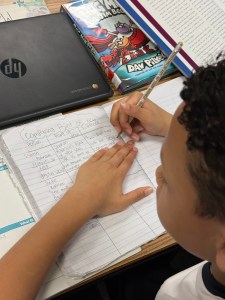
For this particular writing, we began as a class close reading a text about whether or not the penny should be still a coin we use in the United States. Because our focus is opinion, our purpose for reading the text from the standpoint of whether we are for the production of the penny or against the penny’s continuation. A great way to organize thoughts while close reading the text for this purpose is a t-chart that says for on one side and against on the other. I teach my 5th graders to organize this information in their journals. I do not make them create a graphic organizer this way—it is an option. However, they must show me how they organized the information they read in their journals with the purpose of differing opinions. Most of my students chose the t-chart as their organizer, however, some created their own organizers which worked for them.

Class Discussion

Once they completed the reading, each student had to decide whether or not they were personally for or against the production of the penny. As a class we had a discussion of their stance and their why or why not behind their stance. This discussion was so engaging. Listening to their opinions and the reasons behind them based on the text was very compelling. Discussion is an important piece prior to writing. This allows students to voice their opinions, reasons, examples and ideas. I talk about discussion and discourse in my book, Read Outside Your Bubble: Expand Your Bookshelf, Expand Your World. On pages 52-53 of my book, I discuss examples of community agreements you can create in having healthy discourse in your classroom. At the beginning of the year we created community agreements for discussions and we come back to those agreements often.

Students Planning Their Writing

Once students have had their discussions and close read the text, they are able to plan their writing. I have a persuasive/opinion writing plan for them that I use and eventually I wean them off of a plan already set up for them–they eventually draw this plan on their own in their journal. The plan includes an idea for a hook, stating their opinion, three reasons, evidence from the text, elaboration and examples. It ends with a reminder to restate their opinion in a different way. This plan (which is in the video above) is so helpful for students to use to gather their thoughts and begin to writing. Students have said how much this plan is helps them as they begin writing/typing their opinion writings. As students are completing their plans, I make sure that I am a facilitator in that. I model a plan for them which helps them take in my thought process and the ways I look for evidence and brainstorm examples. By modeling for students, it gives them an idea of the level of expectation and teaches them how to plan effectively. When students are creating, I make sure I monitor and meet with students as they are planning. I also have them glue their plans in their ELA journals, because if they lose their plan they are heartbroken because it makes writing easier for them.

Drafting Their Writing

Students use their plan to begin drafting their writing. I also model this. Again, modeling helps students see the pathway forward in their writing. This helps them move from the plan to their writing drafts. Students can write their opinion writings in their journals or they can type it. Most of the time, I have my 5th graders type their writings. Most of them like to type rather than write out their essays, however, sometimes we do write in our journals things like summaries, notes, our thoughts, etc… Students begin using their plan to draft their writing. While they are doing this, I am walking around conferencing with students. Conferencing with students is so essential and doable. I will chat more about conferences next week! In the meantime, follow these steps in getting started with opinion writing with your students. I cannot wait to dig more into how I move into that process!

Chat next week!

A Day in the Life of my Classroom!

My ELA Classroom

As teachers we are often unable or our schedule is not conducive for us to observe other teachers. Although I believe in schools having an embedded culture of learning. I believe it should be common practice. We always wonder, or maybe it’s just me…what happens in other classrooms? I often hear the best professional development is the teacher on your hall or across from you. I believe that we can gain nuggets and ideas from one another just by observing and discussing our observations. 

Let’s imagine…I’m that teacher you are observing across the hall. Imagine you are peeking into my classroom—gaining nuggets. This is a day in the life of my 5th grade ELA classroom. 

📚 Independent Reading

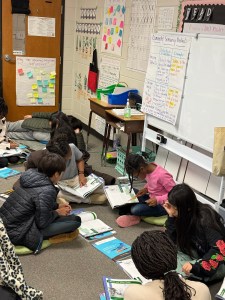
We begin our time for ELA reading for 15 minutes. I allow them to read books of choice. They can read on EPIC, their library books (we go to the school library every week), or from my classroom library. This allows them to practice reading skills we have been learning and get their brains ready for our ELA block. My students enjoy independent reading time.

✏️ Mini-Lesson/Modeling

This week was a focus on point of view from multiple accounts. Our anchor text is Promises to Keep a book about Jackie Robinson written by his daughter Sharon Robinson. This week we dove into multiple points of view from his daughter, Jackie Robinson, the Obamas, and a quick documentary. I modeled how to capture the different perspectives along with evidence using a graphic organizer in my ELA journal 📓 Each student has one as well. 

🧘🏽‍♀️ Partner Work

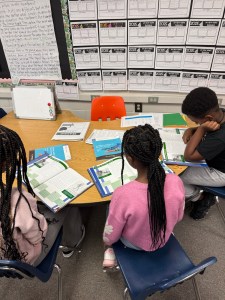
Students then worked together collaboratively to think critically about varying perspectives and ideas that they learned about from the different accounts. They held discussions with each other about the perspectives, what was similar, and what was different about them. Discussions amongst students at this point in the year flow well in my classroom because we established discussion norms at the beginning of the year that we return to often. (In my book  Read Outside Your Bubble, there is a guide how to co-create effective discussion norms for students.) After partner work, we discuss whole group, review what was learned and dive even deeper into perspectives. Students may also write about what they learned in a quick summary in their ELA journals. 

📝 Opinion Writing

I have been modeling opinion writing this week. When I model opinion writing, students are close reading a text (a skill I have modeled all year) to decide their opinion based off what they read. I model using a For/Against chart while they read and an Opinion writing graphic organizer to use. After modeling, I pull skill based small groups to work with based on what I’m teaching while other students are getting started.

Small Groups

During this time I pull students based on skills/support needed. I pull students who may need to work on close reading with a purpose. We may chunk the text to aid with comprehension, have a quick mini-lesson on decoding words and thinking about word meanings, or having a discussion about the text for understanding and clarity. I also have small groups with students who need support organizing their thoughts on the graphic organizer. I also have conferences with my students about their writing. I work with students in small groups to give them what each of them need at the time they need it. My small groups are fluid and flexible. I am intentional about small groups. It takes knowing your students well as readers and writers. 

🗣️ Usually about 40 minutes into writing time, it’s time to go to lunch. I wrap it up with students sharing what they learned about themselves as a reader, writer or learner! 

I hope you enjoyed your Day in the Life! Teaching English and Language Arts can often feel like we are throwing a lot of important ingredients in a big bowl to make a healthy salad. Just know that being knowledgeable, intentional, and aware of what is being put in that bowl is important to student learning and growth.

Today is the Breaking Boundaries Webinar!

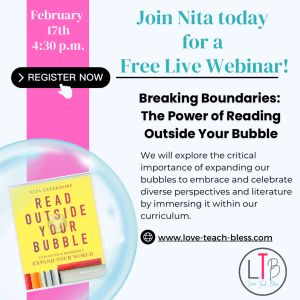
Don’t forget to register to join me today, February 17th at 4:30 p.m. for an, insightful webinar, “Breaking Boundaries: The Power of Reading Outside Your Bubble” where I will explore the importance of diverse perspectives and literature in classrooms. I will offer practical strategies for advocacy and engagement, and share how embracing this will support you in achieving educational excellence in today’s world.

During the webinar, you will:

  • Gain an understanding of the bubble and being locked inside of it,
  • Receive an introduction to the L.E.A.P. Framework (Learning, Equity, Access and Purposeful Professional Learning), and how to effectively engage in this transformative process, 
  • Learn about the benefits of expanding your reading horizons in inclusive ways, and
  • Learn about V.I.B. (Very Important Books) 

At the close of the webinar, you will have an opportunity to ask questions, share insights, and collaborate on ways to create a more inclusive reading culture. 

Don’t miss this opportunity to enrich your understanding of reading outside your bubble to enhance your professional growth!

Note: If you cannot attend, I will send out the recording for those registered!