Learn how to foster student engagement, cultivate empathy, and encourage a love of reading by bringing diverse literature into the classroom in culturally responsive ways!
Using an instructional coaching framework, Read Outside Your Bubble: Expand Your Bookshelf, Expand Your World introduces teachers to a new mindset for helping students develop literacy and become lifelong readers. By building an accessible and inclusive literacy curriculum, you can pique students’ interest in the world outside their bubbles. “Bubbles” are identity markers of race, religion, orientation, and socio-economic status. In this book, as an instructional coach and parent I use a conversational and research-backed approach to introducing my L.E.A.P framework, which guides you through the process of crafting your curriculum. You’ll also learn how to develop lesson plans that increase compassion, cultivate empathy, and encourage a love of reading and history.
Follow the research-backed L.E.A.P. framework to choose diverse reading selections for K-12 classrooms
Learn step-by-step techniques for creating an inclusive curriculum that engages students in literacy
Help turn students into lifelong learners by encouraging them to think beyond their own circumstances and think critically about the world around them
Teach students how to compare and contrast themes and ideas across content areas
The primary audience is teachers, curriculum coaches, curriculum specialists, instructional coaches, and homeschooling parents will appreciate the practical, future-minded approach in Read Outside Your Bubble. This book brings diversity into homes and classrooms in a way that will prepare students to participate in the creation of a more inclusive world.
I would love for you to order my book! I cannot wait to connect with you even more! Check me out on Instagram @loveteachbless! Connect soon!
It was 2001. I was fresh out of college, excited, nervous, and carrying more lesson plans than confidence. Like many new teachers, I was overwhelmed. There were papers to grade, standards to learn, meetings to attend, and an endless list of things I thought I had to do perfectly.
Back then, people talked a lot about creating lifelong learners. We talked about fostering curiosity and developing a love for learning. We talked about passion.
But we rarely talked about joy.
Not teacher joy.
Not student joy.
Looking back now, I realize joy was always there. We just didn’t have the language for it.
Even in the hardest moments, one thing always brought me back: my students.
They were the reason I showed up every morning determined to teach a little better than I had the day before. They reminded me why this work mattered. Long before I realized it, they were fueling my joy.
Twenty-three years later, they still do.
Joy Doesn’t Mean Every Day Is Easy
Over the course of my career, I’ve taught in three states—South Carolina (Go Gamecocks!), Virginia (Go Wahoos!), and now Georgia, where I proudly teach today.
I’ve experienced curriculum changes, new standards, educational trends, leadership transitions, and seasons that stretched me in ways I never imagined.
And I’ve also experienced incredible joy.
That doesn’t mean every day was easy.
Joy is not pretending everything is perfect.
Joy is choosing to stay rooted in hope, purpose, and love—even when the work feels heavy.
Teachers are human.
We get tired.
We get discouraged.
We experience loss, frustration, and moments when we question whether we’re making a difference.
But I’ve learned that joy isn’t the absence of difficulty.
It’s the decision to return to what first called you to this work.
Sometimes we have to re-root ourselves.
Leaving the Classroom…and Finding My Way Back
After thirteen years in the classroom, an opportunity appeared that I hadn’t planned for.
I became an instructional coach.
Some educators step into coaching because they need a change of pace.
That wasn’t my story.
I loved teaching so much that I wanted to multiply that joy by supporting other teachers.
I wanted to become the coach I had often needed myself.
For seven years, I had the privilege of coaching educators—observing classrooms, co-teaching lessons, modeling instruction, asking reflective questions, and celebrating teacher growth.
There is incredible joy in watching another educator discover their own brilliance.
But quietly, something inside me kept whispering.
I missed my students.
I missed hearing, “Good morning, Mrs. Creekmore!”
I missed classroom routines.
I missed planning lessons.
Yes…I actually missed lesson planning.
Most of all, I missed belonging to a classroom community.
The feeling became impossible to ignore.
I felt it in my heart.
I felt it in my spirit.
It was time to come home.
Returning to the classroom reignited something inside of me.
This time, though, it was different.
I wasn’t returning because I had to.
I was returning because I chose to.
I took time to find a school and district aligned with my values—equity, belonging, love, connection, and joy.
That alignment has made all the difference.
Joy Is Intentional
People sometimes assume joyful teachers simply have naturally positive personalities.
I don’t believe that’s true.
Joy is something we cultivate.
It’s something we practice.
It’s something we choose again and again.
Every day I intentionally create small moments that keep me grounded—and over time I’ve watched those same practices begin to shape my students.
Here are a few of the practices that continue to anchor both me and my classroom.
Begin with Intention
Every morning I choose an intention and an affirmation.
I share both with my students.
I’ve noticed something beautiful over time.
When I model intentionality, my students begin creating affirmations of their own.
Our words become anchors for the day.
Build Connections Before Content
I make time to connect with colleagues.
Sometimes it’s simply saying good morning.
Sometimes it’s expressing gratitude.
Sometimes it’s checking on someone who’s had a difficult week.
Relationships don’t just support our work.
They sustain it.
Our students notice how adults treat one another. They learn from what we model.
Smile at the Door
Every student deserves to know someone is genuinely happy they walked into the room.
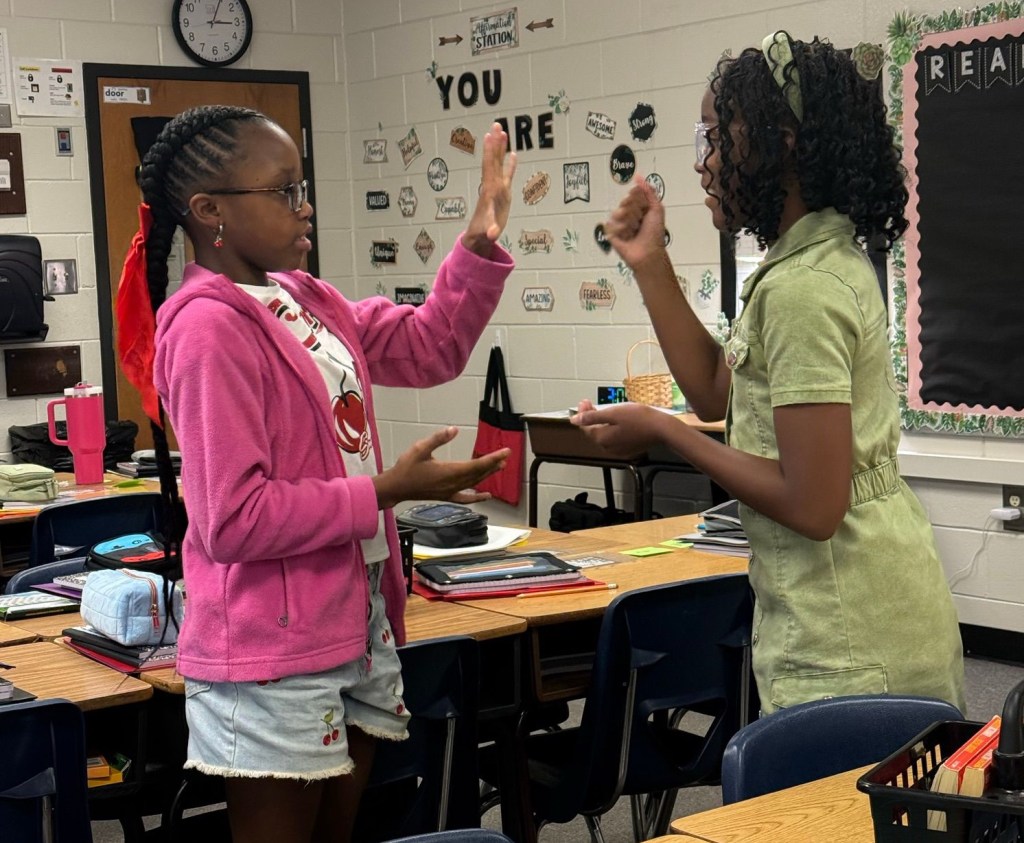
Each morning my students choose how they’d like to be greeted—a hug, fist bump, or high five.
Those few seconds tell them:
“I’m glad you’re here.”
Sometimes they also tell me everything I need to know before the day even begins.
Protect Community Time
Our morning community meetings are sacred.
Sometimes we discuss a quote.
Sometimes we read a picture book.
Sometimes we simply talk.
These moments remind students—and honestly, remind me—that learning begins with belonging.
Pause for Mindfulness
When I notice my own shoulders tightening or my breathing becoming shallow, I pause.
Usually if I need a mindful moment…
my students probably do too.
Sometimes we stretch.
Sometimes we breathe.
Sometimes we practice chair yoga.
These tiny pauses help us return to ourselves.
Laugh Often
Joy loves laughter.
One of my favorite classroom memories happened while reading Esperanza Rising.
Esperanza called Tío Luis a goat.
The room erupted.
Not polite chuckles.
Real, uncontrollable laughter.
Moments like that matter.
Laughter builds safety.
Laughter builds community.
Laughter helps us learn.
Make Room for Wonder
Children are naturally curious.
The more space we create for their questions, the more joy follows.
One of my favorite moments this year?
Watching fifth graders get excited about using an old-fashioned dictionary.
Discovery never gets old.
Joy Is Contagious
As the leader of my classroom, I know my joy sets the tone.
When a student returns after being absent, I tell them:
“We missed you.”
I say “we” intentionally.
Because this classroom isn’t mine.
It’s ours.
I want every student to know their presence matters.
That they belong.
That someone notices when they’re gone.
Joy grows where belonging lives.
But What About the Hard Days?
Let’s be honest.
Sometimes life is hard.
Sometimes our students walk into our classrooms carrying burdens we cannot see.
Sometimes we do too.
Those are the moments when joy can feel distant.
And that’s okay.
I don’t pretend those days don’t exist.
Instead, we talk about them.
We name our feelings.
We acknowledge disappointment.
We practice resilience together.
I’ve learned that resilience often becomes the bridge that leads us back to joy.
That’s one reason I value community meetings so deeply.
They create space for our whole selves—not just our academic selves.
Ask Yourself This
Over the years, I’ve become convinced of one thing:
A joyful teacher doesn’t create perfect classrooms.
A joyful teacher creates classrooms where students know they matter.
Where laughter is welcomed.
Where curiosity is celebrated.
Where hard days are acknowledged.
Where hope always has a seat at the table.
If your students seem disconnected or joy feels hard to find, don’t begin by asking what’s wrong with them.
Begin with yourself.
Ask:
When was the last time I experienced genuine joy while teaching?
What fills me up?
What drains me?
What small practice could help me reconnect with the reason I chose this profession?
Because here’s what I know after twenty-three years in education:
The joy we cultivate within ourselves has a way of spilling into the lives of our students.
And that kind of joy has the power to change a classroom—one relationship, one smile, and one child at a time.
Love. Teach. Bless. Reflection
Before you move on with your day, take a moment to pause and reflect.
What is one small act of joy I can intentionally model for someone today?
Whether you’re a teacher, school leader, parent, or someone who simply influences the lives of others, remember this: joy doesn’t always arrive on its own. Sometimes it begins with a smile, a kind word, a moment of laughter, or the simple act of reminding someone that they matter.
The joy we cultivate within ourselves has a way of spilling over into the lives of those around us. When we intentionally choose joy, we create spaces where people feel seen, valued, and inspired to become the best version of themselves.
One of the most powerful ways we can expand our world (and the worlds of our students) is through the books we read and share. In Read Outside Your Bubble, I talk about what it means to intentionally step beyond our comfort zones to learn from and with others. That same mindset applies when we choose the books we bring into our classrooms and homes.
Books are more than stories; they are mirrors, windows, and sliding glass doors. They reflect who we are, allow us to see into others’ experiences, and invite us to step through and connect in meaningful ways. But here’s the thing—just because a book features diverse characters doesn’t mean it’s truly inclusive or accurate. That’s why vetting the books on our shelves matters.
I created the Vetting Inclusive Books Checklist as a practical starting point. It helps us pause and reflect on the messages, representations, and relationships within the stories we share. Are the illustrations authentic? Are the characters free from stereotypes? Are we reading from authors who share lived experiences with the communities they write about?
When we take time to evaluate our books for inclusivity and truth, we move from performative inclusion to purposeful inclusion. We model for students what it looks like to engage critically—with compassion and curiosity.
As you use this checklist, ask yourself:
Do my students see themselves represented in the stories I teach? Am I offering them opportunities to learn about others with empathy and respect? Am I continuously expanding my own bubble through the stories I choose?
The work of inclusion isn’t a checklist—it’s a journey of awareness, humility, and growth. But this list is a starting point, a reminder that every book we share has the potential to either affirm or erase. Let’s make sure the ones we choose do the former.
Let’s read bravely, love deeply, and continue to expand the bubbles that we read and live in.
Having 1:1 data chats with your students is powerful because it helps students see themselves as active partners in their learning instead of passive recipients.
Why Data Chats are Important
Ownership of Learning – When students see their own data, they begin to understand where they are and what they need to work on. It shifts responsibility from teacher-driven progress to student-driven growth.
Goal Setting – These chats give space for setting realistic, personalized goals. Students are more motivated when they help define what success looks like for them.
Understanding of their data – Many students don’t fully grasp what a test score, rubric, or benchmark means. Talking through it in kid-friendly terms helps them see the “why” behind the numbers.
Confidence & Encouragement – One-on-one conversations allow you to highlight strengths students might overlook. Hearing a teacher affirm their progress builds confidence and resilience.
Differentiated Support – Each student can share what strategies work for them and where they feel stuck. This gives you valuable insight to tailor instruction and interventions.
Stronger Relationships – These chats show students that you care about their individual growth, not just the class average. That personal attention strengthens trust and classroom community.
Learning to Reflect – Learning to reflect on progress, set goals, and adjust strategies is a skill students will need in middle school, high school, and beyond.
1:1 data chats empower students to see their growth, own their learning, and feel supported and seen.
Data Chat Conversation Starters
Starting the Conversation
“When you look at this score/chart, what do you notice first?”
“How do you feel about this result?”
“What part of this makes you feel proud?”
Reflecting on Strengths
“What helped you do well in this area?”
“Which strategies did you use that worked for you?”
“If you could teach another student one tip that helped you, what would it be?”
Identifying Areas to Grow
“Which part feels the trickiest for you?”
“What do you think got in the way this time?”
“If you had one more week to practice, what would you focus on?”
Goal Setting
“What’s one small goal we can set together for next time?”
“What would reaching that goal feel like for you?”
“What can I do as your teacher to support you?”
Looking Forward
“What’s one thing you want to try differently next time?”
“How will you know you’ve made progress?”
“If you could celebrate one success by the end of the quarter, what would it be?”
You should not ask all of these questions. The key is keeping the chat short, positive, and action-focused—so students leave motivated, not overwhelmed.
Data chats help students to see the importance of assessing where they are and reflect on how they want to grow. It allows you as the teacher to build relationships with them and for the student to know you care.