

As an Instructional Coach/Teacher Leader in my school, I have always loved being a part of book studies. Book studies give me life. I think it’s important to participate in a book study/article study at least once a year. Teachers are forever learners and must continue to grow in the field of education. Book studies gives us time to talk, collaborate, hear eachother’s thoughts and grow from one another. But I also believe that book studies should be engaging and fun. Here are the 6 pertinent “must haves” in having a successful book study:
- Decide on which book to study.
- Invite & explain the book club!
- Everyone needs a copy of the book!
- There must be committment to reading the book.
- Plan the book study.
- Make it fun and engaging!
1. Decide on which Book to Read!
My first task when I decided to do a book study was to decide on a book to have it centered around. With all of the hype of the newly released book, The Wild Card, written by Hope and Wade King, it was an easy selection. I also wanted to focus on teaching strategies and teachers finding their creative break through, so this made this book a win-win! It was fun, engaging, interesting, real, and it was an easy read!
2. Create an Email Invite!
In order to get the teachers excited about the book study, I created an email with some of Hope and Wade King’s quotes from The Wild Card that they posted on their Instagram accounts @elementaryshenanigans and @_wadeking. I would embed these quotes at the bottom on my invitation email along with a flyer that I posted in the workroom to get teachers pumped up for the book study. It definitely worked and teachers were excited. I sent emails of different quotes from the book leading up to the first session of the book study!
Hint: Send invites before sessions via email to remind teachers & get them excited about the Wild Card Book Talk Meet Ups!

3. Everyone Needs a Copy of the Book!
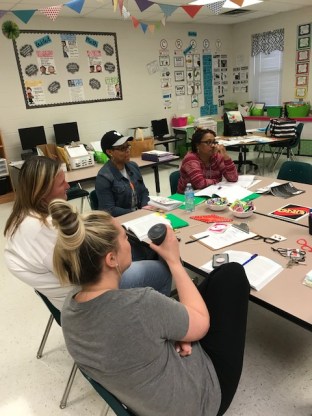
My next task was to make sure everyone had a copy of the book! Initially, I sent out various places for the teachers to purchase the book for about $25.00 on Amazon, $18.00 at Barnes & Noble, etc. But then I decided to ask my principal if there were any funds available in the budget to purchase the books for the staff members who were a part of the book study. She said yes and bought the books for the teachers to use! We were all excited!! Lesson to learn: Don’t be timid to ask for money for the book study if you need it. Face it: we all need it. All admin can say is yes or no.
4. Commitment to Reading the Book
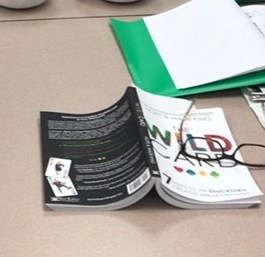
This is important. If the participants do not read the section for the book study meeting, it is challenging to be an active part of the discussions. The depth of the discussions are far more powerful when everyone is a part of it and can pull from the book for references. There is no way to “make” teachers read, however, as they come to the meetings, if you make it engaging and fun, it helps to increase the probability of the teachers wanting to read more of the book!
5. Planning it Out
&
6. Making it fun & engaging
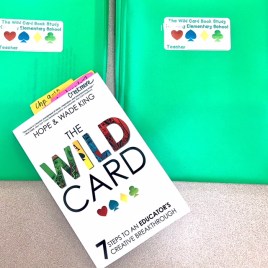
This part of the process has to be a living and breathing document. I would suggest picking the first date for your book club meet up and collaborating to plan out the rest of the dates. I tell you this because, guess what, life happens. Kids get sick, teachers get sick, and you might get sick on the date of your book study meet ups. Flexibility is KEY! But it is good to collaborate on the dates of the next 5 or so sessions so that everyone can discuss and see what works best.
In order for the book club to have some organization. I put everything in a folder in which I gave to teachers before our first session. I created either questions to discuss, made the questions into a game, created a game to play, etc., in order to make each session interesting. The Wild Card Book Study Plan helps to plan out your activities and what you are going to do during each session. The folder had a fun wild card label (picture above) and within it I placed the planning sheet of all the sessions, information sheet about the book, the first set of questions, and 5-6 reflection sheets in the back of the folder. Within each session, I included a fun and engaging activity! I wanted to make sure that the book study meet ups were ones that teachers would enjoy coming to. If you want to get entire The Wild Card Book Study Bundle click here at, https://www.teacherspayteachers.com/Product/The-Wild-Card-Book-Study-Bundle-4616595
The break down of the book/sessions are below:
Session 1
Chapters 1-3 “The Game of Life”, “The Deck is NOT Stacked Against You”, & “Don’t Listen to the Joker”
Gist of this session:
I had given the first sheet of the The Wild Card Book Study Plan to the teachers ahead of time so that they could ponder over the questions and reflect. The first session was a discussion with lots of snacks, chocolate, and soda. We had lots of laughs and tons of reflection! (The Giant Uno Cards I bought from Amazon for $20)
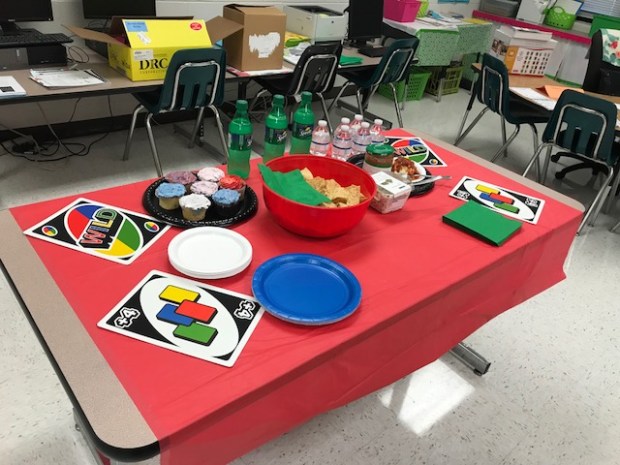
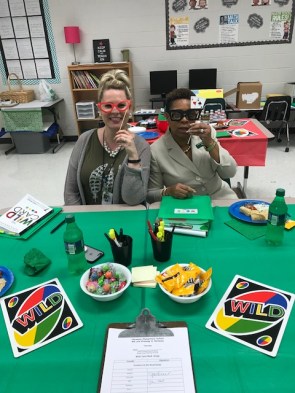
Session 2
Chapters 4-5 “Awareness” & “Desire”
Gist of this session:
In this session we used cards from Miss Mandy’s Editable Wild Card Game and I put the some of the questions from the plan on the cards. We played using the chart shown below. The teachers added up their points and whoever received the most points won prizes. I had some items that were gently used and I also purchased a couple of gifts for the teachers to choose from. This was a fun game and the teachers really got into it!
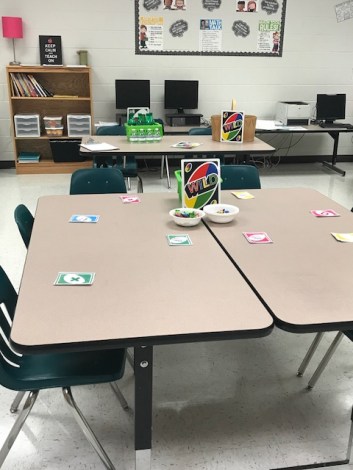
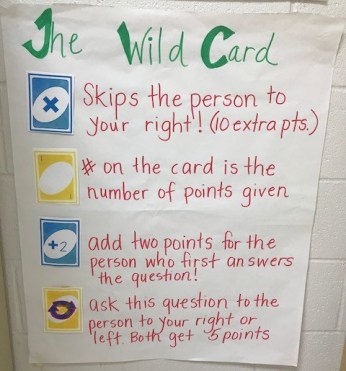
Session 3
Chapters 6-7 “Reflection” & “Engagement”
Gist of this session:
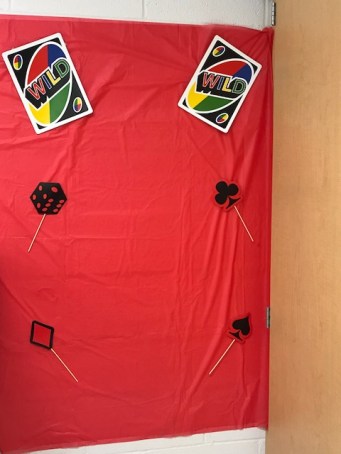
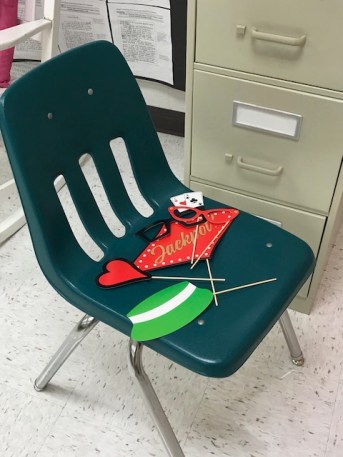
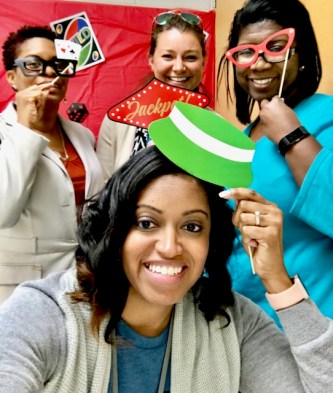
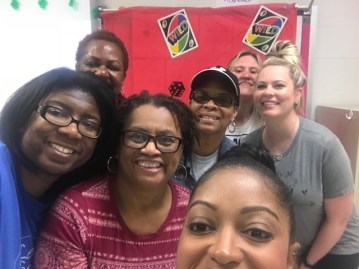
This session was a great reflection session! Teachers took time to reflect and think through some of their strengths and weaknesses as a teacher. For this session, being that we spent time reflecting and discussing, we ended this session with some photo ops! We had deep discussions and why not end it on a fun up-swing with our very own Wild Card Photo Booth!! (I bought the props from Amazon for $10.)
Session 4
Chapter 8 “Authenticity”
Gist of this session:
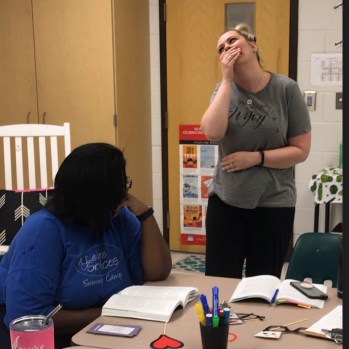
This session was a fun session that helped us think about our authentic selves as teachers. The book talks about comparision being the theif of joy. In this session, we discussed our “Go-To Thing”, the teachers we had in life that “did it” for us, and we even played a game and “acted out” our “thing” for the other teachers to guess what it is! There was some dancing involved and tons of laughs! Needless to say, it was a fun session! For this session, I put the chapter 8 questions on the big UNO cards to pull from! It’s something about those BIG UNO cards that gets us all excited!

Session 5
Chapters 9-11 “Grit”, “Persistence”, & “Snappy Wrap-Up”
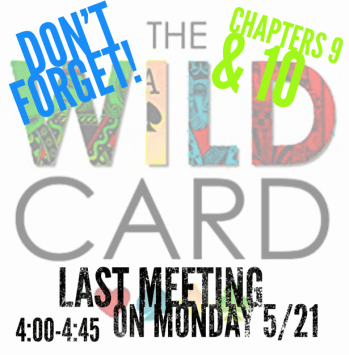
Gist of this session:
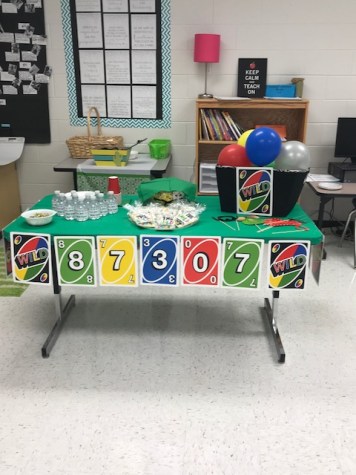
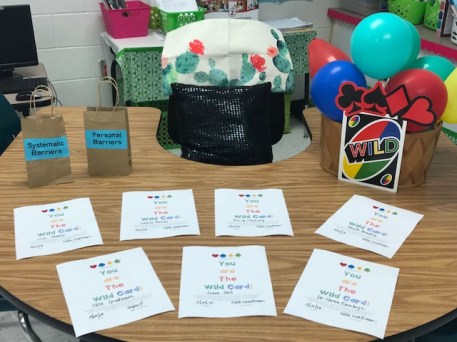
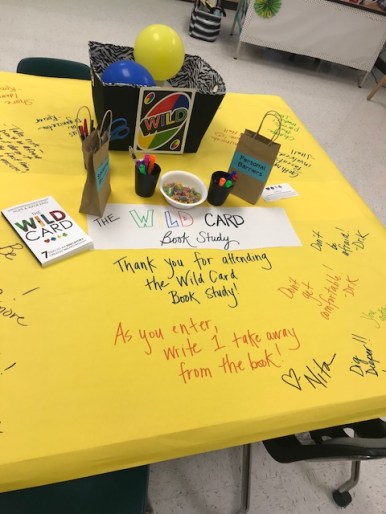
For this last session, it was a fun closure. As the teachers entered the room, they were asked to write their take-aways from the book on the paper on the table. We continued to write some of the take aways as we had our book study meet up as well. We then began the final book study meeting with discussing systematic and personal barriers that could effect our teaching (the “barriers” were placed in brown paper bags). Afterwards, we discussed ways that we can remember to continue to be the Wild Card in teaching. We did this by popping the ballons which had a quote/reminder from the book! The teachers loved it! Lastly, wrote growth goals and looked over some of the ideas in Part III: The Toolbox. We had treats and were given a “You are The Wild Card!” certificate because these teachers EARNED IT!!


A special thanks to the authors of The Wild Card, Hope & Wade King. This book helped to transform our thinking about ways to spark our creative thunder rumbling in us all!!
 Teachers are always checking a student’s comprehension either when we are assessing their reading or performing reading conferences. But in this book it discusses how checking for understanding of plot and setting the checking process has a few parts: understanding what’s most important, summarizing (which students often struggle with), visualizing the setting, and synthesizing cause/effect. Some strategies (many strategies) that stuck out to me to help students through the understanding of fiction text as it relates to plot and setting were the following:
 Love. Teach. Bless.