

My ELA Classroom
As teachers we are often unable or our schedule is not conducive for us to observe other teachers. Although I believe in schools having an embedded culture of learning. I believe it should be common practice. We always wonder, or maybe it’s just me…what happens in other classrooms? I often hear the best professional development is the teacher on your hall or across from you. I believe that we can gain nuggets and ideas from one another just by observing and discussing our observations.
Let’s imagine…I’m that teacher you are observing across the hall. Imagine you are peeking into my classroom—gaining nuggets. This is a day in the life of my 5th grade ELA classroom.
📚 Independent Reading
We begin our time for ELA reading for 15 minutes. I allow them to read books of choice. They can read on EPIC, their library books (we go to the school library every week), or from my classroom library. This allows them to practice reading skills we have been learning and get their brains ready for our ELA block. My students enjoy independent reading time.
✏️ Mini-Lesson/Modeling
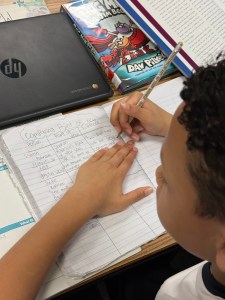
This week was a focus on point of view from multiple accounts. Our anchor text is Promises to Keep a book about Jackie Robinson written by his daughter Sharon Robinson. This week we dove into multiple points of view from his daughter, Jackie Robinson, the Obamas, and a quick documentary. I modeled how to capture the different perspectives along with evidence using a graphic organizer in my ELA journal 📓 Each student has one as well.
🧘🏽♀️ Partner Work
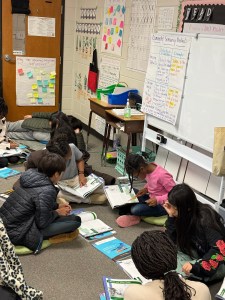
Students then worked together collaboratively to think critically about varying perspectives and ideas that they learned about from the different accounts. They held discussions with each other about the perspectives, what was similar, and what was different about them. Discussions amongst students at this point in the year flow well in my classroom because we established discussion norms at the beginning of the year that we return to often. (In my book Read Outside Your Bubble, there is a guide how to co-create effective discussion norms for students.) After partner work, we discuss whole group, review what was learned and dive even deeper into perspectives. Students may also write about what they learned in a quick summary in their ELA journals.
📝 Opinion Writing
I have been modeling opinion writing this week. When I model opinion writing, students are close reading a text (a skill I have modeled all year) to decide their opinion based off what they read. I model using a For/Against chart while they read and an Opinion writing graphic organizer to use. After modeling, I pull skill based small groups to work with based on what I’m teaching while other students are getting started.
Small Groups
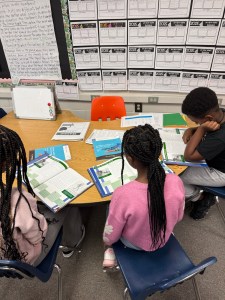
During this time I pull students based on skills/support needed. I pull students who may need to work on close reading with a purpose. We may chunk the text to aid with comprehension, have a quick mini-lesson on decoding words and thinking about word meanings, or having a discussion about the text for understanding and clarity. I also have small groups with students who need support organizing their thoughts on the graphic organizer. I also have conferences with my students about their writing. I work with students in small groups to give them what each of them need at the time they need it. My small groups are fluid and flexible. I am intentional about small groups. It takes knowing your students well as readers and writers.
🗣️ Usually about 40 minutes into writing time, it’s time to go to lunch. I wrap it up with students sharing what they learned about themselves as a reader, writer or learner!
I hope you enjoyed your Day in the Life! Teaching English and Language Arts can often feel like we are throwing a lot of important ingredients in a big bowl to make a healthy salad. Just know that being knowledgeable, intentional, and aware of what is being put in that bowl is important to student learning and growth.



 Love. Teach. Bless.